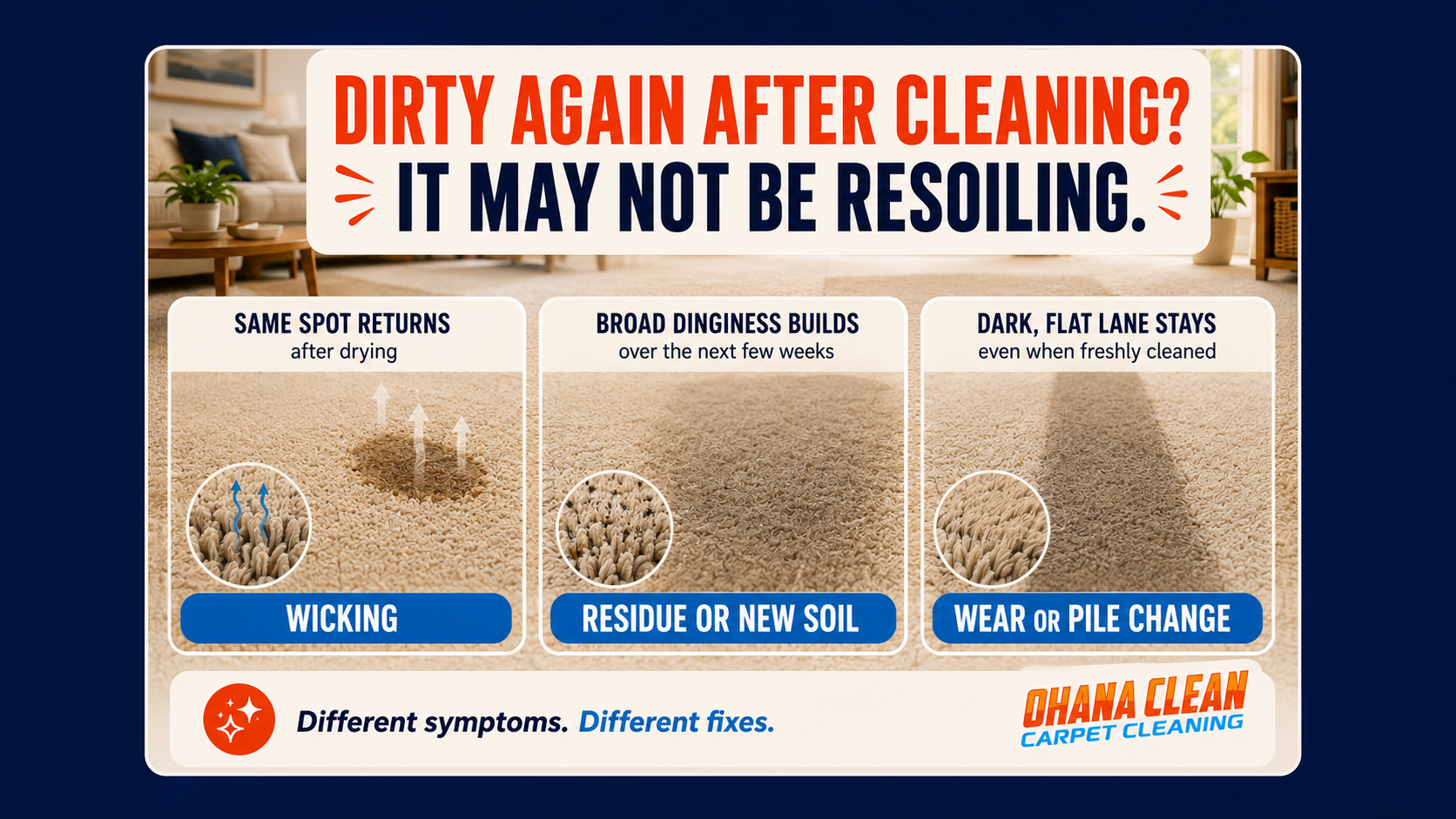
Short answer: Carpet that looks dirty again soon after cleaning is not always experiencing the same problem. A spot that returns as the carpet dries is often wicking. Broad areas that become dingy unusually fast can point to residue, new tracked-in or oily soil, or traffic before the carpet fully dried. Dark, flat traffic lanes may be pile distortion or wear rather than removable dirt. The right fix starts with identifying which pattern you have.
Few carpet problems are more frustrating than seeing a spot or traffic lane return after professional cleaning. Sometimes the process needs correction. Other times, the carpet is showing a deeper spill, new soil, or permanent appearance change. Because those causes need different remedies, a good cleaner should investigate before simply cleaning the area again.
The location and timing usually provide the first clues:
IICRC consumer guidance describes wicking as water-soluble material moving upward or outward while carpet dries. A spill or heavy soil can remain low in the yarn or backing; cleaning moisture can dissolve some of it and carry it toward the visible tips. That is why a spot can look gone while damp and return after drying.
Wicking is more likely when a spill traveled deeply, the area held a heavy soil load, too much moisture was used, extraction was incomplete, or drying took too long. It is a local movement of material, not the entire carpet suddenly attracting dirt.
Urine and large spills may reach the pad or subfloor, where face-fiber cleaning cannot reach the source. Our guide explains why pet urine odor and staining can return.
If a spot returns, let it dry and contact the cleaner before adding another product. The next step may be focused rinsing and extraction, absorbent or low-moisture treatment, faster drying, or an assessment of deeper contamination. Repeated saturation can spread the affected area.
Cleaning residue is a real cause of rapid resoiling. The CRI 205 Residential Carpet Standard warns that stronger-than-directed solution may leave excess residue and contribute to rapid resoiling. IICRC also lists inadequately rinsed detergent and residue from do-it-yourself cleaning or homeowner spot products.
That does not mean carpet should be cleaned with water alone. Oily soil often needs properly selected chemistry. The goal is the correct product and dilution, enough dwell and agitation to release soil, and thorough rinsing and extraction.
Residue may also predate the latest cleaning. A heavily applied spotter, dish soap, deodorizer, or rental-machine solution can remain in the carpet. Tell your technician what was used, even months earlier, because the area may need a different rinse or repeated recovery passes.
The honest distinction: cleaning agents are not automatically soil-attracting, and "chemical-free" is not automatically cleaner. Trouble comes from the wrong product, too much product, or a process that does not remove what should be removed.
Carpet can be clean and still look darker in the path everyone walks. CRI describes crushing as a loss of pile thickness and matting as yarn tips untwisting and tangling under traffic. Changes in pile direction can also make an area look lighter from one side of the room and darker from the other; if that appearance reverses when viewed from opposite directions, pile direction is contributing.
Cleaning may improve the pile, but it cannot rebuild yarn that is permanently flattened, abraded, or chemically changed. Wear can become easier to see after masking soil is removed. CRI's maintenance bulletin also warns that long-standing oily soil can be absorbed into fiber and contribute to color change.
Fiber type matters, but calling one fiber always bad and another always good goes too far. CRI says performance also depends on traffic, style, color, construction, installation, and care. We inspect the carpet in front of us instead of predicting the result from a fiber name alone.
Professional cleaning does not seal carpet away from the home. Particularly relevant Twin Cities examples in the IICRC guidance include road salt, ice melt, blacktop residue, and other tracked-in material. Pets, body lotion, cooking oils, and everyday traffic add different soils, so a busy entry or family room will change faster than a quiet bedroom.
IICRC also lists reopening carpet before it is thoroughly dry as a possible contributor. Damp carpet can receive soil from shoes, feet, furniture, or pet paws before the result has stabilized.
The most useful habits are simple:
Our guide to how often carpet should be professionally cleaned gives practical starting ranges for light, normal, and heavy-use areas.
Reducing avoidable resoiling takes more than a powerful extractor. CRI recognizes truckmount, professional portable, and self-contained hot water extraction systems. Our truckmount provides sustained cleaning and recovery capacity, but the machine alone cannot guarantee a residue-free result.
At Ohana Clean, the complete process matters:
If you notice a concern after the carpet has fully dried, contact us promptly. Under Ohana Clean's 10-day service guarantee, we can evaluate whether you are seeing wicking, residue, new soil, or a pre-existing appearance change and explain the appropriate next step. We promise a thorough process and an honest diagnosis - not the claim that every dark area is removable soil.
Does your carpet keep looking dirty after cleaning?
Request a quote online or call/text (612) 888-8807. Tell us whether one spot returned or a whole area became dingy, how quickly it happened, and what products have been used. Those details help us give you a more useful answer before we recommend another cleaning.
Originally published April 12, 2026. Updated August 7, 2026.
Sources: IICRC Consumer Floor and Furnishings Care Information; CRI 205 Residential Carpet Standard for Maintenance and Cleaning; Carpet and Rug Institute, Carpet Maintenance and Troubleshooting.