Short answer: Pet urine odor can come back when part of the accident remains below the carpet surface. The visible stain may improve while contamination in the backing or pad continues to create odor. The right treatment depends on how far the urine traveled—and sometimes the complete answer is not clear until the carpet has been treated and allowed to dry.
Pet accidents happen, and one isolated spot does not automatically mean the carpet is ruined. Fresh, limited accidents often respond very well to professional treatment. Older or repeated accidents can be more complicated, especially when urine has soaked through the carpet and into the cushion underneath.
At Ohana Clean, we do not assume every pet home needs the deepest or most expensive treatment. We inspect the situation, ask a few practical questions, and match the treatment to what we find. Our goal is to give the carpet its best realistic chance while being honest about what cleaning can and cannot correct.
Carpet is more than the soft fiber you see. Beneath it are backing layers, a cushion or pad, and the subfloor. A small accident may stay close to the surface. A larger accident—or several accidents in the same place—can travel into those lower layers.
If a cleaning only reaches the top while some of the source remains below, the carpet may look and smell better at first. The odor can then become noticeable again as the carpet dries or during humid weather. This does not always mean the pet had another accident; it may mean the original one was never fully reached.
A pet stain and pet odor are also different problems. An oxidizer may improve visible discoloration, while odor treatment must address the contamination causing the smell. One product or one quick pass rarely does every part of the job equally well.
The mark visible from above is not always the full affected area. Once liquid reaches an absorbent pad, it can spread wider underneath the carpet. That is why a small-looking spot can sometimes produce a much larger odor problem.
How difficult the job is depends on several things:
A home machine may improve the surface, but it cannot tell you how far the accident traveled. If odor keeps returning after DIY cleaning, the source may be deeper than the area being cleaned. You can read more about that difference in our rental-versus-professional cleaning comparison.
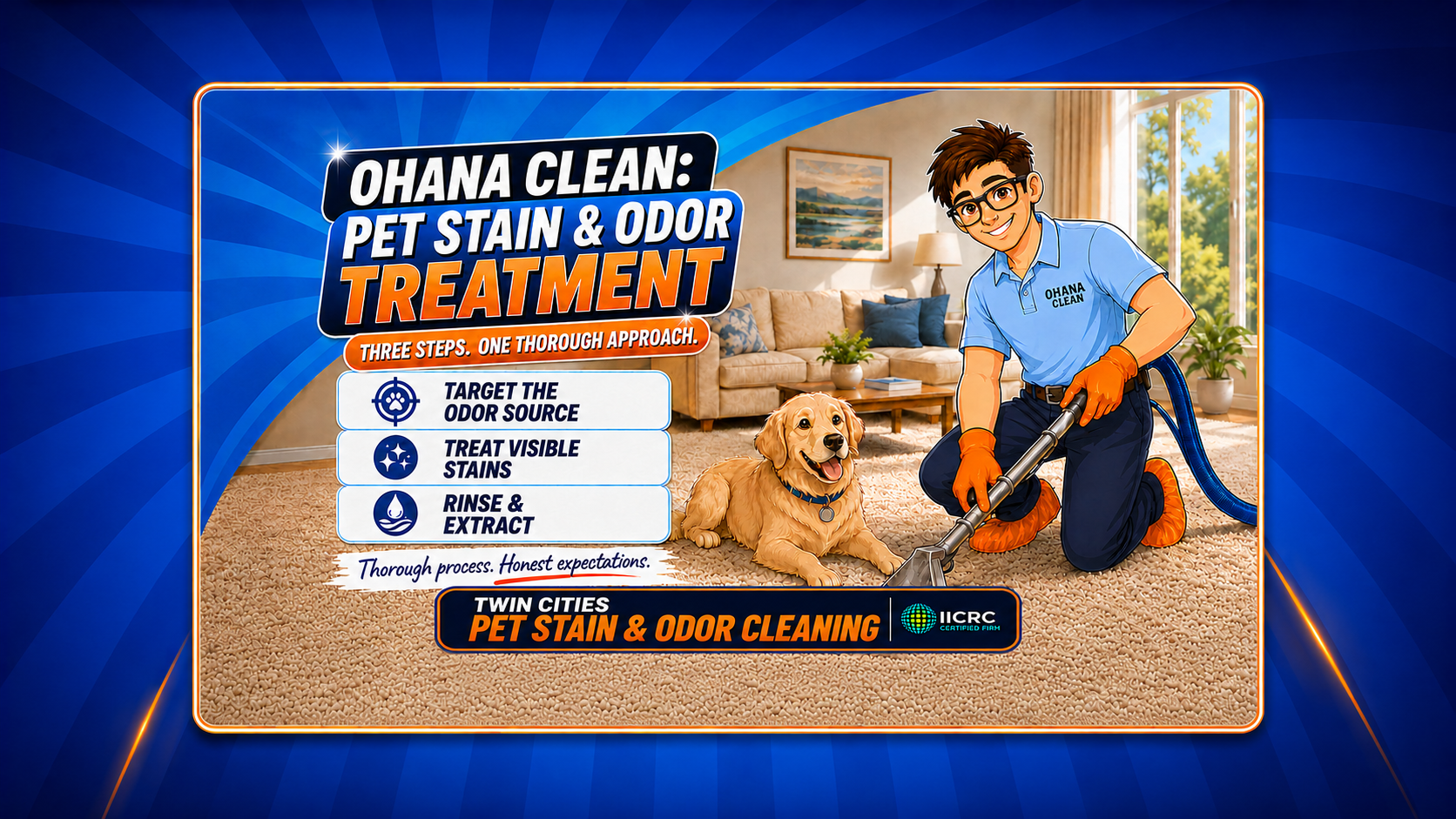
We begin by identifying the known or suspected areas and deciding whether normal carpet cleaning with targeted treatment is reasonable. When appropriate for the carpet, our pet-treatment method uses three different steps because odor, discoloration, and residue are not the same problem:
This gives us a better opportunity to improve both what you see and what you smell than relying on one general-purpose spot cleaner. We adjust the method to the carpet and the severity of the problem instead of treating every home the same way.
If urine appears to involve the backing or pad, a deeper subsurface treatment may be needed. We explain that before proceeding. We do not automatically recommend it for every pet spot, and we confirm any added cost first.
Fresh, isolated accidents are usually the most predictable. Old, repeated, or widespread contamination is harder to judge because the source may extend beyond what can be seen or reached from above.
Inspection helps, but every carpet is different. Two areas that look similar can respond differently because of the fiber, dye, backing, pad, age of the accident, and products previously used. Sometimes the only honest answer is that we will know more after treatment and complete dry-down.
Urine can also permanently change carpet color or weaken the bond between its layers. If contamination has reached a large area of pad or subfloor, the reliable solution may involve lifting the carpet, replacing affected cushion, treating the subfloor, or replacing damaged materials. Carpet cleaning cannot remove a source that remains in a material we cannot access.
That does not mean difficult carpet is hopeless. It means we promise a thorough process and an honest assessment—not the same guaranteed outcome for every home.
Cleaning can remove an existing scent source, but it cannot guarantee that a pet will not have another accident. Sudden or continuing accidents may also have a medical or behavioral cause worth discussing with a veterinarian.
Pet urine is not automatically a disaster, but it is more than an ordinary surface spill. The right question is not only, “Can the stain be cleaned?” It is also, “How far did the accident travel, and can the treatment reach it?”
Ohana Clean addresses the odor source, visible discoloration, and remaining residue as separate parts of the job. If a normal targeted treatment is appropriate, we will say so. If the situation appears to require deeper treatment—or if damaged pad and subfloor may be beyond cleaning—we will explain that honestly.
Need a straightforward opinion on pet stains or odor?
Request a quote online or call/text (612) 888-8807. Ohana Clean is an IICRC Certified Firm serving Minneapolis, St. Paul, and the broader Twin Cities metro.
Sources and further reading: Carpet and Rug Institute: Pet Urine and Carpet; Mohawk Residential Carpet Warranty; ASPCA: Urine Marking in Cats.
Originally published February 23, 2026.
Updated August 6, 2026.