Short answer: Plan on professional cleaning about once a year. Light-use homes may go 12-18 months, and low-use rooms may go 18-24 months. Busy homes with children, pets, indoor shoes, or heavier traffic often make more sense on a 6-12 month schedule. Under heavy conditions, 3-6 months may be appropriate.
No cleaning schedule fits every home. A quiet guest bedroom does not collect soil at the same rate as a staircase used all day, and one adult with no pets will not create the same conditions as a busy family.
The better question is not simply, “How many months has it been?” It is, “How much use and soil has this carpet received?” That is the practical idea behind IICRC guidance, and it is how we make maintenance recommendations at Ohana Clean.
The ANSI/IICRC S100 standard covers professional maintenance and cleaning of residential and commercial textile floor coverings. IICRC guidance has long organized cleaning frequency around soil conditions rather than one rigid annual rule. Ohana translates that approach into these practical residential starting points:
These ranges are guides, not a timer designed to sell the shortest interval. Start with the range that resembles your home, then adjust based on what the carpet actually looks and feels like at the end of that cycle.
Clean sooner when a home has more of the following:
Carpet fiber, construction, and color can affect how quickly soil becomes visible and how well the carpet holds its appearance. They matter to the cleaning process, but they do not create one fixed schedule for every nylon, polyester, olefin, or wool carpet.
You do not have to deep clean the entire home every time one area is due. Stairs, hallways, family rooms, and carpet near entrances often need service before guest rooms, closets, and carpet that sits under furniture.
Cleaning active areas more often and low-use rooms less often is usually more sensible than either delaying everything or paying to clean carpet that has barely been used. It also puts the IICRC soil-condition approach into practice: maintenance follows actual use.
Definitely not. Carpet changes gradually, so homeowners often become used to traffic lanes and dulling before realizing how much soil has accumulated. A better goal is to clean while the carpet is still in maintainable condition, not wait until every room looks dramatically different.
Useful signs that the next cleaning may be due include:
Cleaning removes soil; it does not reverse every appearance problem. Crushing, permanent matting, fading, pile direction, and worn fibers may remain after the carpet is clean. An honest cleaner should explain that difference before promising that a dark or flat traffic lane will look new again.
Regular vacuuming is the best way to control loose dry soil between professional cleanings. Once a week is a reasonable minimum for lightly used carpet; busy lanes and pet areas may need it several times a week. Slow, overlapping passes, clean filters or bags, entry mats, and prompt spot care can extend the time between deep cleanings.
Vacuuming still does not remove every oily or sticky soil that bonds to carpet fibers. That is where periodic professional cleaning fits into the maintenance plan.
Do not assume that a general industry range overrides your carpet warranty. Manufacturers set their own cleaning methods, intervals, documentation, and service-provider requirements. The CRI 205 residential standard says to clean as needed, at least every 24 months, and to follow the carpet manufacturer's frequency to maintain warranty coverage. Keep your professional cleaning receipts in case you ever need them.
If your warranty asks for a trained or certified professional, Ohana Clean is an IICRC Certified Firm. We can document the service performed, but the manufacturer's written warranty remains the final authority.
Commercial carpet should be managed as a maintenance program because traffic is concentrated and often repeats along the same paths every day. These are useful starting points:
The right commercial frequency depends on foot counts, weather exposure, entry matting, vacuuming, color, fiber, and how quickly visible lanes return. A written plan is more useful than waiting until the whole building looks dirty.
At Ohana Clean, we do not automatically recommend the shortest interval. After seeing the soil we remove, the condition of the traffic lanes, and how the carpet responds, we can give you a more useful recommendation for the next cleaning. If a low-use room can wait, we would rather say so. If a staircase or family room needs attention sooner, we will explain why.
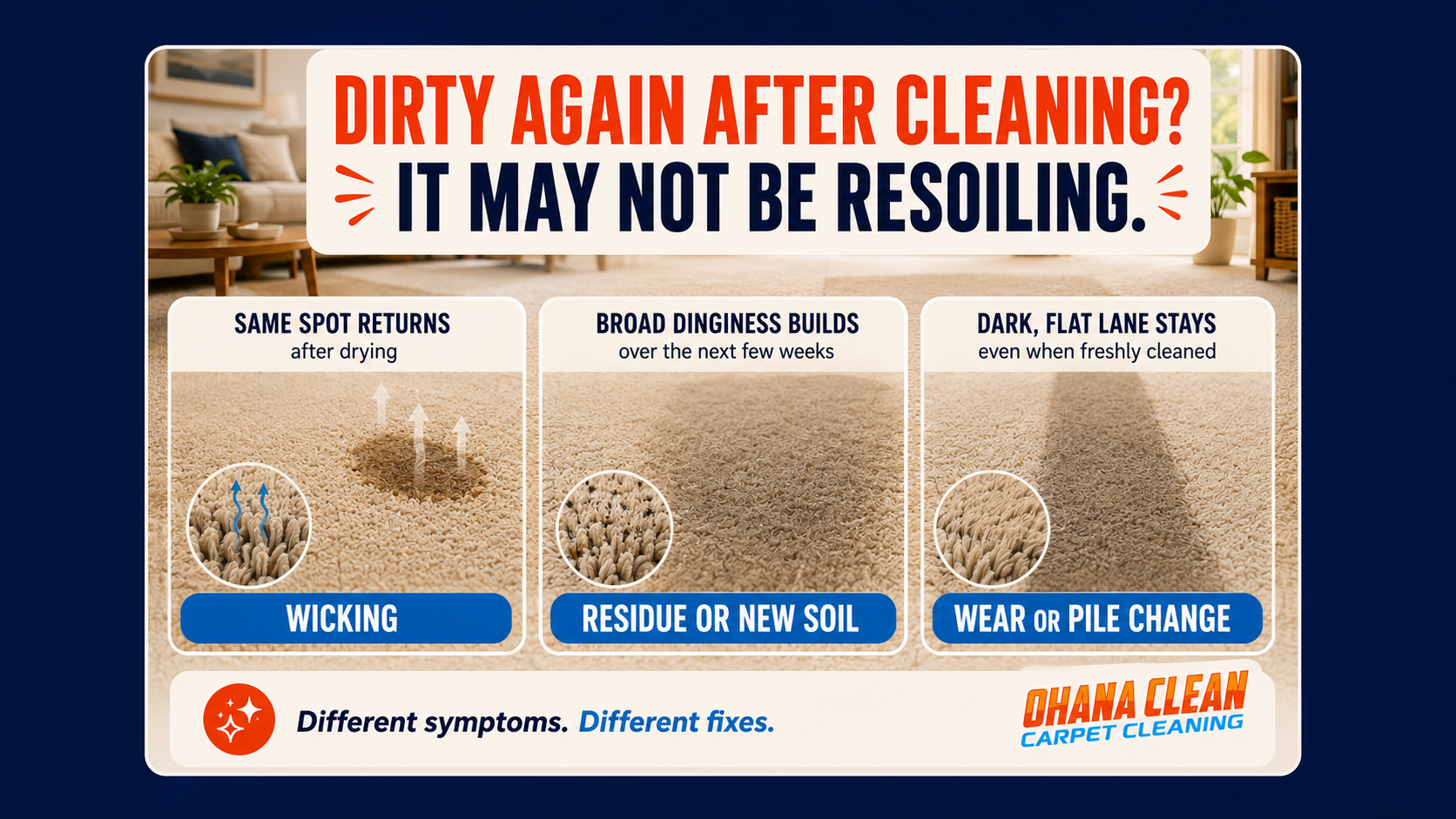
If carpet becomes dingy again unusually fast, more frequent cleaning may not be the whole answer. Residue, incomplete dry-soil removal, worn fibers, or an ongoing source of soil may be involved. Our guide to why carpet gets dirty quickly after cleaning explains those possibilities.
Not sure whether your carpet is due?
Request a quote online or call/text (612) 888-8807. Tell us when it was last cleaned, who uses the home, whether you have pets, and which areas concern you most. Ohana Clean serves Minneapolis, St. Paul, and the broader Twin Cities metro.
Originally published May 5, 2024. Updated August 7, 2026.
Sources: ANSI/IICRC S100 overview; IICRC-based residential frequency chart; CRI 205 Residential Carpet Standard.