Short answer: Wool carpet can be professionally deep cleaned, often with controlled hot water extraction. But wool is less forgiving than common synthetic fibers, and not every wool carpet responds the same way. The safest process depends on the carpet's construction, dye stability, condition, contamination, and cleaning history - not the word "wool" alone.
Wool can be extremely durable under years of foot traffic. That does not mean it is equally tolerant of every cleaner, spot treatment, or long-neglected spill. In the cleaning world, wool can feel fragile because mistakes and prolonged contamination may affect the dye or fiber in ways that ordinary soil removal cannot reverse.
We see this most clearly with pet urine. The contamination and odor may improve substantially, yet a yellowed, lightened, or color-shifted area can remain because the carpet has already been chemically changed. Both CRI's pet urine bulletin and IICRC consumer guidance warn that urine reactions can develop over time and permanently affect dyes or fibers. An honest evaluation separates what can be cleaned from what may already be permanent.
Some wool carpets are surprisingly robust and clean beautifully. Others require much tighter limits. Several variables affect how a particular carpet responds:
This is why "wool-safe" should describe a decision process, not just a bottle of cleaner. Two carpets that both say wool on the label may not call for the same chemistry, agitation, moisture, or spotting procedure.
Wool is a natural protein fiber. Strong alkalinity, aggressive oxidizers, unsuitable spotters, excessive agitation, and uncontrolled moisture can create risks that may be lower on many synthetic carpets. Those risks include color movement, yellowing, texture change, fuzzing, or weakening of the fiber.
The WoolSafe Organisation's cleaning guide emphasizes three recurring causes of wool-cleaning damage: over-wetting, too much mechanical action, and unsuitable chemicals. It recommends pretesting wet-cleaning procedures and selecting products made for wool and wool-rich carpet.
That does not mean wool must receive a weak or surface-only cleaning. It means the cleaner has to create enough cleaning action without pushing any one variable too far. Chemistry, temperature, agitation, moisture, extraction, and drying all work together.
Yes. Controlled hot water extraction can be an appropriate deep-cleaning method for many installed wool carpets. It can remove embedded soil and residues more thoroughly than an interim surface-cleaning method. The phrase "hot water extraction" does not mean maximum heat or maximum moisture; both should be adjusted to the carpet in front of us.
Low-moisture cleaning can also have a role, especially for interim maintenance or when inspection identifies a reason to limit moisture. It is not automatically safer or more complete. WoolSafe notes that there is no single best technique for every wool carpet; the construction, soil, risk factors, and operator's control determine the right approach.
Pet urine is not just another spot. Repeated or long-neglected deposits can travel through the pile into the backing, pad, and sometimes the subfloor. On wool, they may also alter the fiber or dye before a cleaner ever arrives.
That creates three separate goals:
Success in one area does not guarantee success in all three. A treatment may remove much of the contamination and odor while permanent yellowing or dye loss remains. If urine reached the pad or subfloor, cleaning the face fiber alone may not resolve the odor source.
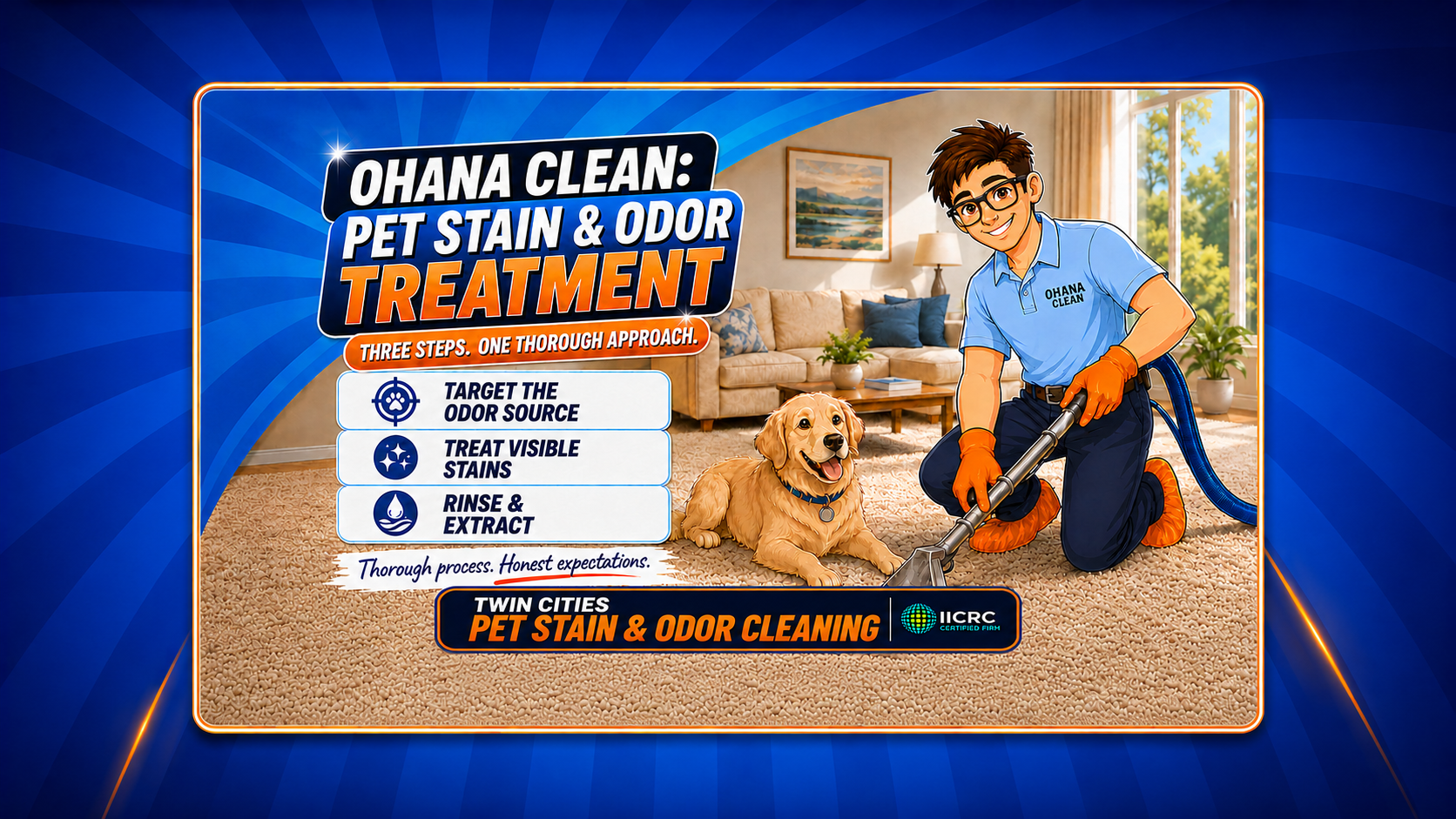
A product marketed for pet urine is not automatically appropriate for wool. The label must specifically permit use on wool, and color-loss risk may still require testing. IICRC consumer guidance warns that some oxidizing treatments are not recommended for wool or other natural fibers without extensive testing. We choose wool-compatible treatment and stop when further stain removal would create more risk than benefit. Our separate guide explains why pet urine outcomes depend on depth and prior damage.
Our promise is the process and the assessment: we will work within safe limits and explain what changed. We will not promise that every old urine mark, faded area, or chemically damaged spot can be returned to its original color.
Installed wool carpet (Wall-to-Wall Carpet) and movable area rugs may share a face fiber, but their construction can be very different. A rug may include unstable dyes, cotton or jute foundations, fringe, hand-knotting, latex, glue, silk, viscose, or other blended materials that change the cleaning risk.
Many installed wool carpets can be safely cleaned in the home. Some area rugs are also suitable for careful in-home maintenance, while others should receive specialty rug cleaning in a controlled facility. We would rather recommend the safer setting than force every wool textile into one process.
Our process begins before moisture touches the carpet:
Ohana Clean is an IICRC Certified Firm. That certification does not make every wool carpet predictable; it supports the inspection, testing, documentation, and professional judgment needed when the variables matter.
Wool often responds beautifully to the right cleaning. Dry soil, oily residue, and general dulling can be removed; colors may look clearer and the pile may feel more defined. But cleaning cannot rebuild worn fiber or automatically reverse fading, old dye loss, bleach damage, urine-related color change, or every texture difference.
Between professional cleanings:
Cleaning frequency should follow use and soil rather than one rigid calendar. Our guide to how often to clean carpet explains practical intervals for light, normal, and heavy-use homes.
Need help with wool carpet in the Twin Cities?
Request a quote online or call/text (612) 888-8807. Tell us whether the carpet is installed or a movable rug, where the concern is located, and whether pets, spills, or previous spot products are involved. We will inspect first, explain the safest practical option, and tell you honestly when discoloration may be permanent.
Originally published April 27, 2026. Updated August 7, 2026.
Sources: The WoolSafe Organisation, The Cleaning & Maintenance of Wool Carpets; Carpet and Rug Institute, Pet Urine and Carpet; IICRC Consumer Floor and Furnishings Care Information; ANSI/IICRC S100 overview.